
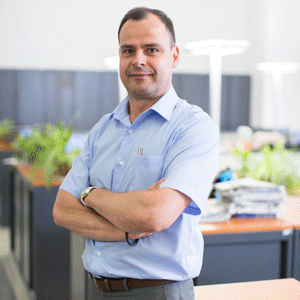







Eve Klaric, CIO, Uniform Group
Eve Klaric, CIO at Uniform Group, is a results-driven, proactive business professional with a passion for people leadership, project management, process improvement, and process optimization.
She is recognized for her critical thinking and problem-solving abilities, as well as her demonstrated leadership and decision-making skills. She also has extensive experience across endto-end business processes, from strategic planning through execution, with a proven ability to lead and influence cross-functional teams to achieve results.
Building Connected Growth
I have always believed that technology leadership is ultimately about people, processes, and purpose. At Uniform Group, my role as Chief Information Officer has been shaped by this belief as I oversee systems, software, hardware, networks, infrastructure, vendor relationships, and strategic technology planning across Australia and China.
However, my journey at Uniform Group has extended beyond traditional IT leadership. I have also led one of the organization's most significant digital transformation initiatives, guiding the business from fragmented legacy systems toward an integrated technology foundation designed for sustainable growth.
When I joined Uniform Group, I quickly recognized that the organization had grown successfully over many years, but its technology environment had evolved in a way that created complexity. Different systems had been introduced at different times, resulting in disconnected platforms, manual workarounds, and limited visibility across the business. The opportunity was clear: We needed to create a unified ecosystem that would support our current operations while preparing us for the future.
Creating a Foundation for Growth
My first priority was developing a strategic plan for digital transformation. This involved building a strong business case, presenting it to the steering committee and board, gaining approval, managing the tender process, selecting the right technology partners, and leading the implementation journey from beginning to end. The goal was not simply to replace old systems. It was to create a scalable platform that would enable Uniform Group’s continued expansion over the next five to ten years.
A major part of this transformation was finding a solution that could provide a single source of truth across our operations. With manufacturing facilities in China and business operations across Australia, having accurate, real-time information was essential. Previously, different systems could provide different answers, making decision-making more difficult. We needed simplicity, integration, and scalability.
Over a 14-month period, we successfully delivered a comprehensive Business digital transformation program, replacing a heavily customized legacy environment with a modern, cloud-based technology ecosystem across Australia and China.
The program included the implementation of a new cloud ERP platform, demand and supply planning software, a manufacturing planning solution with real-time visibility, an enhanced e-commerce platform, integrated point-of-sale systems, new middleware, enhanced warehouse management capabilities, introduced finance automation solutions, and integrated freight and shipping software.
Looking back, the scale of the achievement is something I am incredibly proud of. Delivering such a broad transformation required coordination among multiple vendors, internal cross functional teams, and business stakeholders. It also involved working with several implementation partners simultaneously, which required strong governance, clear communication, and disciplined project management.
Building Through Collaboration
I have always believed that successful technology transformation cannot happen in isolation. Technology must be built with the business, not simply delivered to the business. That philosophy shaped our approach from the beginning.
Before selecting any new system, we spent three months engaging with teams across Uniform Group to understand our current environment, identify challenges, and define future requirements. We worked with every function across the organization because each team had unique insights into how technology could improve its daily operations.
This process helped us document our business requirements clearly and prioritize them using the MoSCoW method, identifying what we must have, should have, could have, and would not have. This approach allowed us to separate essential capabilities from desirable features and helped us create a practical roadmap for implementation.
More importantly, this collaboration created alignment across the organization. Teams that had traditionally operated within their own functions developed a deeper understanding of each other's priorities, requirements, and challenges. This fostered shared ownership of the transformation and ensured the technology strategy supported the organization's broader business objectives while preserving the unique value proposition we have developed through 35 years of partnering with our customers.
Leading with Trust and Transparency
My leadership approach has always focused on relationships, integrity, and transparency. Whether I am working with internal teams, executives, or external partners, I believe trust is the foundation for achieving meaningful outcomes.
-
I Have Always Believed That Successful Technology Transformation Cannot Happen In Isolation. Technology Must Be Built With The Business, Not Simply Delivered To The Business. That Philosophy Shaped Our Approach From The Beginning.
During a transformation of this scale, challenges are inevitable. My approach has always been to address challenges openly, seek support when needed, and create an environment where people feel comfortable sharing ideas and concerns. This openness encourages collaboration and allows teams to solve problems together.
I place significant importance on creating a culture where people feel empowered, engaged, and connected to the transformation journey. The success of any project is not measured solely by the technology delivered, but by how well people embrace change and become active participants in it.
The dedication and commitment of our teams were instrumental in delivering such a significant transformation within a short timeframe. This achievement would not have been possible without their expertise, resilience, and collaboration, together with the unwavering support and sponsorship of our leadership team.
Creating the Right Environment for Success
One of the most important decisions I made was establishing a dedicated project team focused entirely on the transformation. Large technology projects often struggle when employees are expected to manage business-as-usual responsibilities while also delivering major change initiatives.
To avoid this challenge, I created a team with diverse expertise across change management, global operations, finance, data migration, and business processes. I transformed our boardroom into a dedicated project room where the team could collaborate, track milestones, review requirements, and maintain visibility throughout the journey.
This physical space became a symbol of our shared commitment. The walls displayed our transformation goals, timelines, responsibilities, and key deliverables, alongside motivational memes and funny images that gave us a reason to laugh during the tough times. It created an environment where everyone involved could see what we were working toward and understand how their individual contributions mattered.
My advice to other CIOs leading major transformation programs is simple: Invest in the right team structure from the beginning. Give people the time, resources, and support they need to fully focus on the project. Asking teams to balance major transformation initiatives alongside day-to-day operational responsibilities often creates unnecessary risk and reduces the likelihood of achieving the desired outcomes.
Driving Continuous Improvement Through Technology
As technology continues to evolve, I see the CIO role becoming increasingly connected to business strategy. The future belongs to organizations that can adapt quickly, use information effectively, and create experiences that support customers, employees, and partners. My focus remains on ensuring that Uniform Group continues to build on the capabilities we have established.
The transformation has also strengthened our ability to make informed decisions. With connected systems and improved visibility, leaders across the organization can access better insights, respond faster to opportunities, and plan with greater confidence. This is the true value of digital transformation: not just new platforms, but the ability to operate with greater clarity and purpose.
Technology as an Enabler of the Future
The completion of our digital transformation has placed Uniform Group in a stronger position for future growth. We now have integrated systems that provide greater visibility, improved operational efficiency, and a foundation that can support continued expansion.
For me, the role of a CIO is not only about implementing technology. It is about understanding the business vision, connecting people with possibilities, and creating solutions that deliver long-term value. Technology should simplify complexity, enable better decisions, and empower teams to achieve more.
At Uniform Group, our transformation journey has reinforced my belief that successful digital change happens when technology, people, and strategy move forward together. By building strong relationships, encouraging collaboration, and maintaining a clear focus on business outcomes, we have created more than a new technology environment. We have created a foundation for continued innovation and growth. I remain committed to learning, improving, and partnering with teams to ensure technology continues to create meaningful impact throughout Uniform Group’s future.