


APAC CIOOutlook
About UsConferencePartner With Us
  • Technologies
    • Blockchain
      Data Intelligence and Management
      Digital Transformation
      FinTech
      Generative and Agentic AI
      Low Code No Code
      Mobile Application
      Networking
      Robotics
      Storage
      Wireless
  • Industries
    • Automotive
      Aviation
      Banking
      Construction
      E-Commerce
      Food and Beverages
      Healthcare
      Insurance
      Logistics
      Manufacturing
      Retail
      Supply Chain
      Travel and Hospitality
  • Platforms
    • Microsoft
      Salesforce
      SAP
  • Strategic Solutions
    • Business Intelligence
      Contact Center
      Corporate Finance
      CRM
      Cyber Security
      Data Center
      Enterprise Asset Management
      Enterprise Performance Management
      IT Infrastructure and Services
      Managed Services
      Procurement
      Unified Communication
      Workflow
  • Home
  • CXO Insights
  • Leadership Perspectives
  • Innovation Insights
  • Research
  • News
  • Whitepapers
  • CXO Awards
#

Apac CIOOutlook Weekly Brief

×

Be first to read the latest tech news, Industry Leader's Insights, and CIO interviews of medium and large enterprises exclusively from Apac CIOOutlook

Subscribe

loading

THANK YOU FOR SUBSCRIBING

  • Home
  • CXO Awards
  • Top 10 CTOs in APAC - 2026
  • Jorge Fernandes
Editor's Pick (1 - 4 of 8)
left
Digital transformation - Gaining Momentum in Operational Technology (OT)

Martin Schlatter, CIO and Regional CEO, APAC, NTT Security

Connecting dots the IOT way!

Sunil Singh, Regional Chief Information Officer, Coca-Cola Beverages Vietnam

Disrupting the Automotive Industry through Digitalization

Esteban Remecz, CIO, Asia Pacific, ZF Group

Simplifying Deployment and Management of Branch Office Networks

Ari Bose, CIO, Brocade

Internet-of-Things: The Rise of Connected Businesses and Connected Lives

Harnath Babu, CIO, KPMG India

How IOT is Driving Competitive  Advantage to Asian Supply Chains?

Steve Walker, CIO, DHL Supply Chain Asia Pacific

Embracing Advanced Tech-enabled Solutions that Foster Innovation and Growth

Steven Weinreb, CIO & EVP, Technology & Operations, Asia, MetLife

Digital Transformation with Purpose

Eve Klaric, CIO, Uniform Group

right

Building Networks Ready for Change

Jorge Fernandes, Group Chief Technology Officer, Singtel

Tweet
content-image

Jorge Fernandes, Group Chief Technology Officer, Singtel

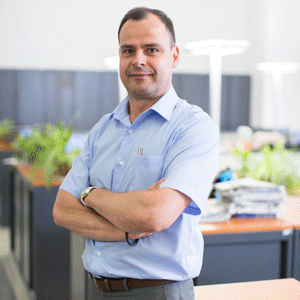
Jorge Fernandes serves as Group Chief Technology Officer at Singtel, where he oversees technology strategy, network evolution and infrastructure priorities across one of Asia-Pacific’s largest telecommunications groups. His career spans leadership roles across Europe, the Middle East and Asia, including senior positions at Vodafone and Deutsche Telekom. His work consistently centers on preparing large communications networks for changing customer demands and emerging technologies. Managing Technology Beyond the Network The scope of responsibility for telecommunications technology leaders is expanding. The performance of the network still matters, but customers' expectations are increasingly driven by cloud technology, digitization, cybersecurity and artificial intelligence. This is where Fernandes comes into play. His duties are not only about ensuring that everything is connected. They consist of assessing how technology will affect the future needs of services while taking into account costs, resilience and timeliness. It is rare that decisions can be made in silos in telecommunications companies. Even changes in a network structure can have an impact on customer relations, enterprise solutions and capital expenditure in different markets. The job that Fernandes does requires thinking ahead about the impact of technology choices, which might become clear only after several years. This approach to the problem has been growing more and more important as the telecommunications industry examines how to use new technologies in its existing environment. Turning Infrastructure Into Business Capability Discussions about technology tend to revolve around the rollout of hardware and the application of software. However, it is important to ensure the relevance of the infrastructure as business needs change over time. In this regard, it is interesting to note Fernandes' public advocacy for software-defined network technologies, automation, and cloud-based systems. These reflect a concerted effort on his part to push telecoms technology towards solutions that allow for agility. Indeed, the impact of such efforts is made clearer by taking into consideration the extent of his responsibilities. Serving millions of clients and enterprise clients necessitates the need for technology that is reliable while still providing leeway for additional services.
Often enough, telecommunication companies find themselves under pressure to offer additional capabilities without compromising on their performance. From this perspective, Fernandes' experience may suggest a preference for technologies that will allow meeting both of these demands. It should be noted that his experience working with several international telecommunications companies has exposed him to various regulatory regimes, different investment schedules and varying client expectations. This seems to have influenced his approach towards leadership and implementation over adoption. Keeping Emerging Technology Grounded Artificial intelligence is now a topic that comes up in almost every area of technology. Because AI initiatives frequently rely on network performance, data management, and infrastructure preparation, telecommunications leaders face additional complexity. Fernandes has discussed the connection between future digital capabilities, such as AI-enabled services, and network upgrading. The deployment of new tools is not the only topic of discussion. It entails setting up the underlying technological environment necessary for those tools to function efficiently at scale. Making disciplined decisions is necessary for such preparation. Technology executives need to assess how infrastructure investments fit with long-term company goals, where automation enhances results, and where human control is still required. These choices are made throughout a network footprint that supports enterprise clients, consumer services, and regional connectivity needs within Singtel's technology division. Technology planning is inextricably linked to more general business realities due to the role's nature. A realistic grasp of the relationship is evident in Jorge Fernandes' leadership. He continues to concentrate on building technological underpinnings that can meet future needs without neglecting present responsibilities. The lesson is simple for telecom CEOs dealing with comparable constraints. Sustainable technological progress focuses less on pursuing every emergent trend and more on constructing ecosystems capable of adjusting when substantial change happens.
tag

AI

Data Management

Weekly Brief

loading
Latest Awards
Top 10 CTOs in APAC - 2026

I agree We use cookies on this website to enhance your user experience. By clicking any link on this page you are giving your consent for us to set cookies. More info

APAC CIOOutlook
Follow on LinkedIn

About

  • Home
  • About Us
  • Partner With Us

Stay Connected

  • Subscribe
  • Newsletter
  • Sitemap

Contact Us

  • editor@apacciooutlook.com
  • sales@apacciooutlook.com
  • marketing@apacciooutlook.com

Legal

  • Editorial Policy
  • Privacy Policy
  • Terms of Use

© 2026 APAC CIOOutlook. All rights reserved. Headquarteblue in Fort Lauderdale, FL, USA.

This content is copyright protected

However, if you would like to share the information in this article, you may use the link below:

https://internet-of-things.apacciooutlook.com/views/building-networks-ready-for-change-nwid-10857.html