

A featured contribution from Leadership Perspectives: a curated forum reserved for leaders nominated by our subscribers and vetted by the Construction Tech Review Advisory Board.

AXA Affin Life Insurance
Moving From Traditional Insurance Models to New Age Models

Rohit Chandrasekharan Nambiar
What has brought us to this situation? Why a model so simple (i.e. protecting people and helping them to build their wealth) has become so complicated?
There are five reasons behind this in my view:
1. Insurance is one of the very few businesses where we pay money upfront as a customer, for a service that we may or may not need after a period-of-time. In today’s fast-paced world, customers want to see value immediately.
2. Because of the high fraud rates in product lines like motor and health, we have to put a customer through a more stringent process (even the ones who are genuine).
3. Insurers create products which are highly compartmentalized and specialized. In the bargain, we are perceived to have more exceptions than inclusions.
4. Dependence on part-time intermediaries whose interests may not be aligned to that of the customer, a professional intermediary or the insurer.
5. Legacy issues stemming from inflexible core systems and resultant processes.
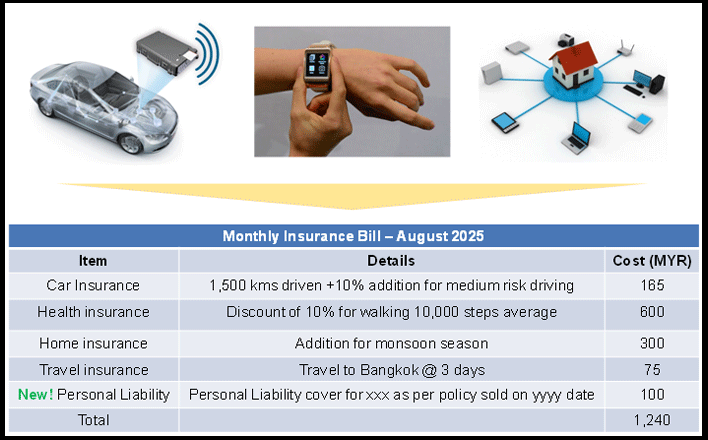
This industry is plagued by the legacy systems we are tied to and by a project management philosophy which focuses on project completion and its adoption. We have too many mobile apps in the market with minimal adoption. The simple reason for this is that we haven’t talked to the customer or distributor enough before we launch an app. Launching an app in today’s market is the easy part. Adoption is a function of management will, customer value, and engagement mechanism designed (i.e. content). New age business model using IoT, RPA, AI, and Big Data helps quash these specific challenges stemming the growth of our industry. With the help of telematics, wearables technology, connected homes, and the like, this industry will move from underwriting on a pre-payment basis to a usage-based industry, similar to utilities like telecom and electricity. As a customer, we will pay bills based on our actual usage during the past month.
While some elements are already seen in many markets, we are yet to see a fundamental transformation that encapsulates the concept above. But, I am convinced that we will see this in the years to come.
With the help of telematics, wearables technology, connected homes, and the like, insurance industry will move from underwriting on a pre-payment basis to a usage-based industry.
How can this be achieved?
1. IoT is at heart of this revolution and helps transform the business model by enabling new interaction models which weren’t even conceivable a few years back.
2. Big Data is critical to facilitate customer segmentation, pricing, and servicing based on data flow through from multiple IoTs.
3. RPA will help streamline processes as technology always has a gap to facilitate to end-to-end innovation. In some cases, RPA can also be a permanent plug.
4. With the help of AI, we can help weed out fraud much faster, ensuring that a good customer has a seamless interaction with the company and is not subject to process complexities.
5. Advent of multiple niche start-ups and specialist firms who help large companies like AXA to embrace these technologies very quickly.
How can we begin a transformation journey?
1. Initiate the journey by defining or reiterating a core purpose and vision.
At AXA, we have a very inspiring one from our Group CEO, Thomas Buberl- “There is no great company without a great purpose: ours is to empower our 107 million customers to live a better life.”
2. Define sponsors for each element of your journey. Sponsorship is not akin to being a Manager. Sponsors are in charge across the life span of the project. Not just pre, but post launch as well.
3. Set in motion a cultural transformation programme aimed at driving lean and agile thinking within the company. Lean lends itself to Agile as it removes wastage and simplifies a process. Post which, we can apply agile principles to implement new systems.
4. Execute in small chunks and be ready to have your own set of failures and learnings. Don’t believe any consultant who tells you that the ride will be smooth. It becomes smoother after a lot of mistakes, false starts and getting beaten up.
5. Do not under-estimate the importance of change management. Every project should have a change manager who works with the business units to co-own adoption KPIs.
AXA Affin General Insurance, Malaysia has launched telematics based motor insurance in the market. Customer can view the discount he has earned at any given point in time on his mobile App. And in our focus to move from a “payer to partner”, we send across an ambulance for an accident above a certain threshold and provide our customers with theft assistance. This was enabled through a partnership with CSE, who enable our execution locally.
We also implemented RPA extensively. We have used simple screen scrappers like Nastie and also more sophisticated BPM tools like UIPath to automate processes involving multiple systems. Most of these robots go-live within a time frame of less than four weeks and we have seen tangible business benefits. In some cases, with the help of lean and robotics, we have removed up to 80-90 percent of steps.
