

APAC CIOOutlook
About UsConferencePartner With Us
  • Technologies
    • Blockchain
      Data Intelligence and Management
      Digital Transformation
      FinTech
      Generative and Agentic AI
      Low Code No Code
      Mobile Application
      Networking
      Robotics
      Storage
      Wireless
  • Industries
    • Automotive
      Aviation
      Banking
      Construction
      E-Commerce
      Food and Beverages
      Healthcare
      Insurance
      Logistics
      Manufacturing
      Retail
      Supply Chain
      Travel and Hospitality
  • Platforms
    • Microsoft
      Salesforce
      SAP
  • Strategic Solutions
    • Business Intelligence
      Contact Center
      Corporate Finance
      CRM
      Cyber Security
      Data Center
      Enterprise Asset Management
      Enterprise Performance Management
      IT Infrastructure and Services
      Managed Services
      Procurement
      Unified Communication
      Workflow
  • Home
  • CXO Insights
  • Leadership Perspectives
  • Innovation Insights
  • Research
  • News
  • Whitepapers
  • CXO Awards
#

Apac CIOOutlook Weekly Brief

×

Be first to read the latest tech news, Industry Leader's Insights, and CIO interviews of medium and large enterprises exclusively from Apac CIOOutlook

Subscribe

loading

THANK YOU FOR SUBSCRIBING

A featured contribution from Leadership Perspectives: a curated forum reserved for leaders nominated by our subscribers and vetted by the Construction Tech Review Advisory Board.

PwC

Chris Bartlett, Partner

Future-Proofing the Fourth Industrial Revolution With IoT Security

Chris Bartlett

Chris Bartlett

The Internet of Things (IoT) is relevant to more and more businesses around the world today. According to a recent PwC survey, as many as 89 percent of businesses in the Asia-Pacific believe that the IoT is critical to their business, yet only 44 percent express a high degree of confidence that they are building sufficient levels of digital trust into IoT (see figure below). It’s a familiar story: businesses will openly claim they are dependent on security, but are more focused on productivity and revenue growth rather than safeguarding the business they have. In the IoT world, a slack attitude to security doesn’t just contribute to the risk of adverse business events, but can place an entire business in jeopardy. This is because the innovations in applications of IoT technology connects traditionally disparate parts of a business’ value chain, spanning different business units, assets, partners, suppliers, employees, vendors, and customers. In the IoT world these different parts of a business can be distributed across different countries, crossing jurisdictional boundaries and open to interception by parties often well outside the control or detection capabilities of an organisation. In short, an increasing number of businesses are becoming dependent on the world of the IoT, but they are increasingly losing control over their data and future sources of value.

According to the GSMA, the global mobile industry trade body, “security lies at the heart of the emerging fourth industrial revolution.” As the number of connected things continues to grow and begin to outnumber humans, IoT security is becoming “ever more important.” If customers or business managers are not able to place their trust in innovations in areas such as smart door locks, industrial machinery, supply chain partners’ reporting, remotely monitored energy meters or smart traffic sensors, then trust in the broader digitalisation of society will also be in jeopardy. As we have seen through the Royal Commission into Financial Services in Australia, trust is a matter that worries the heads of financial services companies, aged care providers, and IT and telecom operators.

Not Surprisingly IOT Security is expected to become a Big Business


IoT security featured high on the agenda during Mobile World Congress in Barcelona last month, the conference that brings together the mobile telecom industry’s leaders into an annual pilgrimage of demos, use cases, and keynotes. The context was simple: 5G and IoT technologies are critical to enabling the fourth industrial revolution (4IR), and the mobile industry must safeguard connectivity to maintain trust. According to an expert from the UK Government who spoke at MWC, we are still at a basic level of competence in IoT security as there is a lack of understanding and incentives to pursue it. Companies do not reward staff for implementing security measures, and typically do not penalize them for avoiding or bypassing security.

Not surprisingly IoT security is expected to become a big business. Companies must first understand the principles and criticality for IoT security, particularly at the communications network level, where mobile operators must play a role. Then they need to develop guidelines and implement IoT security controls in the enterprise environment.
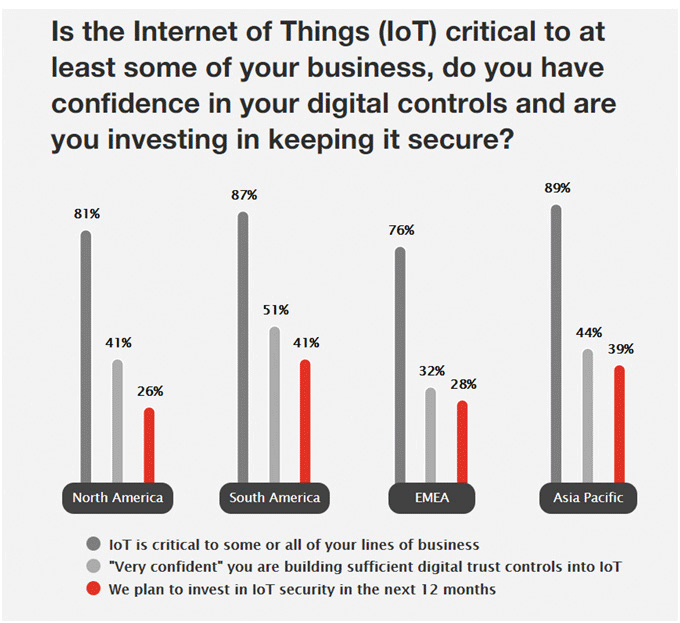

Source: PwC Global State of Information Security Survey, 2018

The effort to create a culture of awareness for IoT security risks is critical, but lacking in most businesses today. Countries such as Australia also have a challenge around the shortage of available IoT security skills in the market, since graduate output lags demand and professionals in this space often go to work abroad or else will get snapped up by a few high paying companies.

Australia needs an IoT security action plan if we are to scale up our capability as well as build trust in the benefits of digitization.

The articles from these contributors are based on their personal expertise and viewpoints, and do not necessarily reflect the opinions of their employers or affiliated organizations.
The Leadership Perspectives forum brings together voices shaping construction technology and innovation. Participation is by invitation only. It features leaders who are not merely observing technological change, but actively contributing to it through digital transformation and execution-driven insights.
EDITOR'S CHOICE
  • Willis Towers Watson

    Just Group [GBX: JUST.L]

    Empowering Retail through Customer-First Technology Adoption Strategy

    Frank De Sa, Chief Information Officer

  • Willis Towers Watson

    ISS Facility Services Australia & New Zealand

    The Right Technology And Reliable Partners; The Business Next Frontier

    Luke O'Brien, CIO

  • Willis Towers Watson

    BPAY Group

    Building BPAY Group's New Digital Foundation

    Angela Donohoe, Chief Information Officer

  • Willis Towers Watson

    Bvn Architecture

    How Have Recent Advancements in Big Data Been Impacting Businesses?

    Marc Solomon, CIO

I agree We use cookies on this website to enhance your user experience. By clicking any link on this page you are giving your consent for us to set cookies. More info

APAC CIOOutlook
Follow on LinkedIn

About

  • Home
  • About Us
  • Partner With Us

Stay Connected

  • Subscribe
  • Newsletter
  • Sitemap

Contact Us

  • editor@apacciooutlook.com
  • sales@apacciooutlook.com
  • marketing@apacciooutlook.com

Legal

  • Editorial Policy
  • Privacy Policy
  • Terms of Use

© 2026 APAC CIOOutlook. All rights reserved. Headquarteblue in Fort Lauderdale, FL, USA.

This content is copyright protected

However, if you would like to share the information in this article, you may use the link below:

https://internet-of-things.apacciooutlook.com/leadership-perspective/futureproofing-the-fourth-industrial-revolution-with-iot-security-nwid-6145.html